
Webinar Recap | Beyond Compliance: Building School-Based Mental Health Programs That Work
Held on: July 26, 2025
Organized by: Mindset Plus Philippines
Supported by: Save the Children Philippines
Why This Webinar Mattered
When it comes to school mental health, it’s easy to jump straight into compliance checklists. But this webinar wasn’t about ticking boxes — it was about asking the right questions.

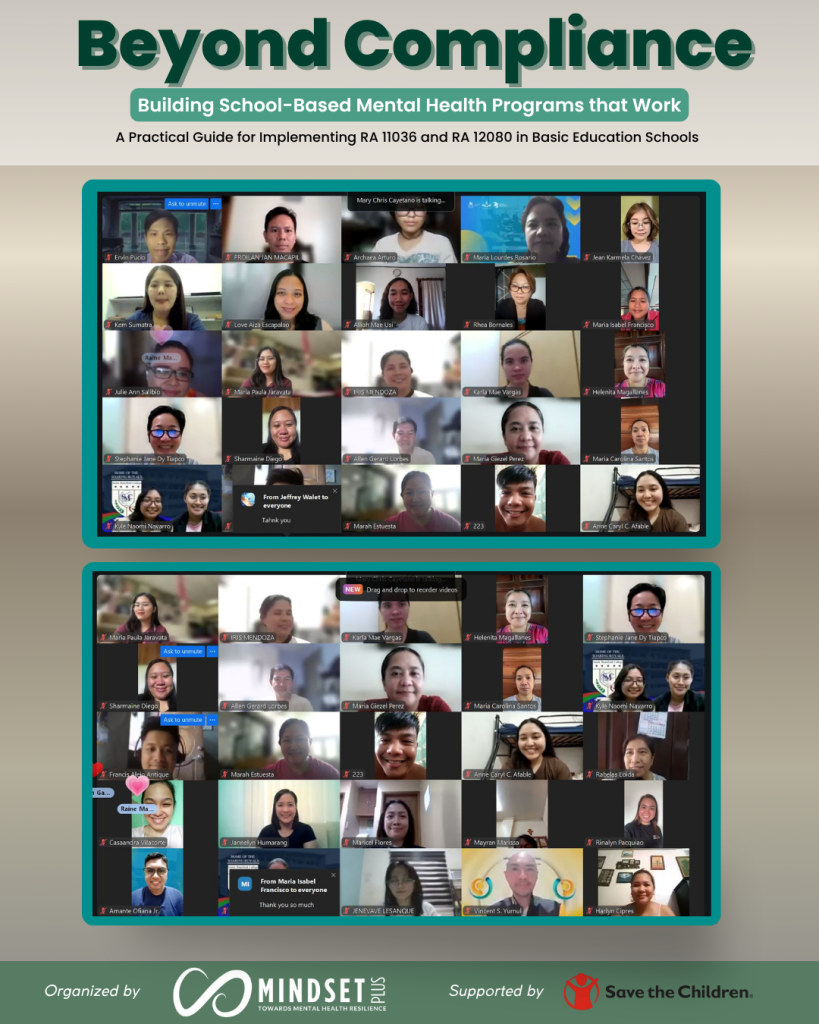
Mindset Plus invited participants to pause and reflect, not just on laws like RA 11036 and RA 12080, but on the lived realities of students, teachers, and families navigating an often-invisible mental health crisis in schools.
Our four guiding questions shaped the discussion:
- Where are we, really, in implementing the law
- What are we already doing that counts — and what’s still missing
- Who’s left behind in our current approach — and why
- What small, concrete steps can we take this school year?
What followed was a powerful, multi-perspective conversation that blended policy, personal stories, and global insight — reminding us that real change begins not with perfection, but with courage, compassion, and care.

Grounding in the Law: RA 12080 and RA 11036
Our opening speaker, Gian Erik Adao, walked us through the key provisions of RA 12080 — the Basic Education Mental Health and Well-Being Promotion Act — and how it builds on the framework set by RA 11036.
Gian is an Educational Program Specialist II at the Department of Education’s Bureau of Learner Support Services–School Health Division. He is part of the Health and Wellness Team spearheading national programs such as the School Mental Health Program, Adolescent Reproductive Health, and the National Drug Education Program.
His background is a powerful blend of policy development, capacity-building, and community-rooted education. Before his current role, Gian served as a project officer for the DepEd–Tobacco-Free Kids Action Fund, advocating for tobacco control in schools. He is also part of the Technical Working Group of the Philippine Council for Mental Health, where he helped draft the Implementing Rules and Regulations of the Mental Health Act.
He reminded us that this law isn’t optional — it mandates all basic education institutions to embed mental health into school systems, not just activities. And for schools unsure where to begin, Gian offered this: start where you are, but start now.
Voices of Hope: When Support Is Personal
This segment highlighted the lived experiences of parents who’ve had to navigate systems that weren’t always ready for their children.

First, we heard from Teacher Caroline de Vega, or Teacher Carol — a mother to Polly, a 16-year-old with autism. A graduate of UP Diliman in Family Life and Child Development, Carol ran her own preschool in the Philippines before moving to the United States to find better support for her daughter.
Now based in California, Carol is a certified grief recovery and trauma-informed care practitioner, the parent coordinator for E-Soccer, and the founder of Moms Helping Moms, a support group for caregivers of neurodivergent children. She also launched Polly’s Café, a pop-up initiative creating inclusive workspaces for people with disabilities.
Her story was a reminder that when systems don’t work, families are forced to leave — not because they want to, but because they need to.
We then heard from Wea Mae Sabado, a homeschooling parent and Managing Director of Journeys of Faith Home Education, who relocated from Singapore to Manila. Drawing on her experience in two very different education systems, she shared key contrasts in how mental health and developmental support are integrated — or not — into schooling. Her reflections challenged us to consider how inclusion can be built structurally, not just informally.
From the Eyes of Global Experts
Mindset Plus also brought together a powerhouse panel of international experts, who each offered strategies drawn from global contexts but relevant to the Philippine reality:

Constanza Gonzalez
A Chilean clinical psychologist with over a decade of experience, Constanza specializes in psychotherapy for cross-cultural and displaced populations. She has worked across Chile, Brazil, Argentina, the U.S., and the Philippines, and currently supports culturally diverse clients in both English and Spanish.
Her emphasis: raise mental health literacy school-wide — not just among counselors, but among teachers, staff, and even students. She also urged honesty about what schools can and cannot provide, and reminded us that the principle of “do no harm” must guide all school mental health efforts.
Dario Lipovac
Dario is a Cognitive-Behavioral Therapist and the Global Senior Advisor for MHPSS (Mental Health and Psychosocial Support) at Save the Children US. He’s led mental health programs in countries affected by conflict, displacement, and poverty — including Ukraine, Uganda, South Sudan, Indonesia, and the Philippines.
Dario shared what schools can do when infrastructure is lacking: build culture first. Emotional safety comes from trust, consistency, and trained adults who know when and how to refer. He encouraged schools to co-create solutions with students — not just for them.
Franck Tsafack
Franck is a global MHPSS consultant who previously served as UNICEF’s Technical Consultant in Papua New Guinea, where he helped integrate psychosocial support into schools. His work spans education, humanitarian emergencies, and community care.
Franck emphasized psychoeducation to reduce stigma, especially in communities where mental health is still taboo. He advocated for equipping teachers and caregivers with tools to recognize and respond to student needs — and creating spaces where seeking help is normalized.
Mauricio Sánchez
Mauricio is a clinical and educational psychologist from Costa Rica with a unique background in music therapy and trauma-informed care. He holds degrees in Psychology, Educational Psychology, and Music Education, and has developed resilience hubs for children living in high-risk areas.
Mauricio’s work with World Vision Costa Rica’s Casa Club hubs showed that mental health support can be both creative and low-cost — integrating music, art, and structured play as tools for emotional healing and learning.

Panel Discussion: From Law to Lived Experience
The final segment brought together local voices from across sectors — showing us how policy becomes real through practice:
- Carol De Vega shared what systemic failure feels like for families of neurodivergent children, reflecting on how the lack of inclusive support in the Philippines forced her to leave the country. She emphasized the urgent need for early intervention, caregiver support, and school systems that truly listen to parents.
- John Vincent Felix, a licensed psychologist and expressive arts therapist at Magis Creative Spaces, discussed minimum skill sets school personnel need to recognize early signs of distress — especially where no psychologist is available. With over a decade of experience and award-winning advocacy, John continues to combine clinical practice with creative modalities in education.
- Gladys Mintu, Principal of South Mansfield College, emphasized how school leadership can act now by building internal capacity and mapping out what’s doable even before full implementation guidelines are released.
- Jojilen Vanessa Gluda, Safeguarding and DEI Specialist at Save the Children Philippines, highlighted the often-overlooked intersection of mental health and child protection — especially for children experiencing abuse, discrimination, or disability. As a Registered Social Worker with lived experience of visual disability, Vanessa brings a deeply personal and systemic lens to her work.
- Gian Erik Adao returned to emphasize how DepEd is planning for equity in implementation, particularly in schools with limited access to mental health professionals or located in remote areas.

Rea Celine Villa, clinical psychologist and Mindset Plus PH co-founder, wrapped up the panel with a reminder:
“Implementing these laws isn’t about having it all figured out — it’s about showing up, asking better questions, and committing to small, meaningful action.”
Final Thoughts: Real Change Starts With Us
As RA 12080 opens the door to systemic change, it’s now our shared responsibility to walk through it. Whether you’re a teacher, school head, parent, or policymaker — the path to mental health in schools is one of collective action.
And at Mindset Plus, we’re here to walk with you.
Stay Connected
Join our communities and get updates, tools, and training:
Facebook Group: bit.ly/MindsetFBCommunity
Viber Community: bit.ly/MindsetViberCommunity
Spotify: bit.ly/MindsetSpotify
YouTube: bit.ly/MindsetPlusYoutube
Join the conversation